Apparently there were some 19th century fangirls.
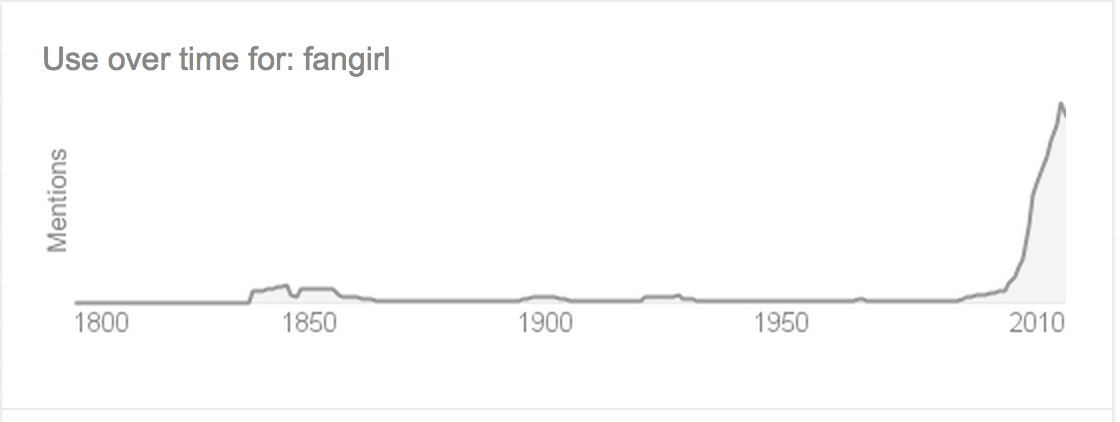
Use of the word “fangirl” in popular literature. I wonder what books caused that spike from 1840-1860? Maybe fandoms aren’t so new after all…
Use of the word “fangirl” in popular literature. I wonder what books caused that spike from 1840-1860? Maybe fandoms aren’t so new after all…
FAN•GIRL (n) An extremely or overenthusiastic fan of someone or something
It’s the spring of 2012 and I’m driving down to suburban Philadelphia in a Ford Escape full of thirteen-year-old girls (six, to be exact) so that we can line up and wait inside a mall for a boy band I had yet to hear of. To clarify, I’m the one physically driving the SUV – it’s the spring 2012 and I’m a sophomore in college who somehow ended up as the designated teen cousin chaperone over one (not at all) wild and (entirely un-) crazy Spring Break. And so there I was, heading down the PA Turnpike to a CD signing for a pop group I didn’t know existed until just a few hours before. Of course, I got a crash course in everything on the trip down: the group was called One Direction, they formed on some reality TV show which apparently only aired in the UK but which my younger cousin and her friends watched in full via YouTube (#internet), there are five of them.
Now, let’s fast-forward to today in the fall of 2014 so I don’t have to explain the rest. If you’re reading this, chances are you are already quite familiar with the 1D-mania that ensued after that genuinely cool mall tour. (I mean, for a British boy band that exploded globally via distinctly twenty-first century media outlets to tour malls? Suburban malls. In the middle of America. Even the most hateful haters have to respect that retro hustle.) But even for the uninitiated, little explanation is necessary because the entire phenomenon proves no different than the teen pop sensations that came before.
For this reason, I’m writing in defense of the Fangirl. Apologies for all the liberal arts buzzwords I’m about to drop, but the term and how those who live with the label are treated just holds all sorts of problematic implications. To begin, there’s the omnipresent need for an immediate pop culture shaming of any young girl who maybe feels some sort of feelings for her favorite pop star, actor, or character. From the second she feels a totally normal attraction to another human, she is told those feelings are silly, insane, or inappropriate. Yes, the fervor of fangirls seems to strengthen with every new pop culture sensation, but that’s simply because of the technologies and media forms in constant proliferation. If YouTube existed in the 1960s, I guarantee the Beatles’ Ed Sullivan Show debut would have easily racked up hundreds of millions of views. If Tumblr existed in the 1990s, there certainly would have been some New Kids on the Block fan fiction. If Twitter existed in the 2000s, Justin Timberlake surely would have racked up millions of followers before he turned twenty-one. The girls haven’t changed, but society has.
Moreover, it’s important to note the blatant and harmful (here’s that buzzword) heteronormativity of it all. Certainly, not all fangirls are female and not all females are fangirls. To make such a blanket assumption ignores and subsequently invalidates the just-as-normal feelings of an entire sector of guys and girls. It’s just not okay.
For most, to fangirl provides an escape. Watch the made-for-TV documentary “Crazy about One Direction,” (available in full on YouTube) and such a message – regardless of the demeaning narrative controlling the whole thing – emerges. Each girl, despite a constant push to make them seem crazy, shows that she is “crazy” about One Direction mostly because the world 1D creates allows her respite from life she perhaps isn’t all too happy with. There’s the girl who lives in the outskirts of London who dreams of Zayn to forget about the mother and brother she has to care for. There’s the girl who loves Harry because (as the filmmaker distinctly pointed out) she has never had a real boyfriend. These girls aren’t crazy, they’re just into something that puts a smile on their face – something that real life rarely ever does. Can you blame them?
As sort of an OG fangirl of sorts (shoutout to you, ramen-haired Justin Timberlake wearing Tommy Hilfiger overalls and ski googles from the poster that hung above my childhood bed) I can see the argument that so much of the “Directioner” coverage makes, claiming the connection this specific generation has with their boy band as something too intense for something so immaterial. When any member of One Direction or some similar faction tweets, for example, it is all to easy for a devoted fan to think said member is speaking directly to them, specifically. Or, when a fangirl spends hours in front of the computer watching endless YouTube interviews of his/her idols, it again proves likely that he/she will get lost in a world seemingly so familiar, but one that exists a world apart. It follows, therefore, that the fan establishes this false notion of intimacy that proves dangerous not only for them, but for their idols. Chances are they’ll forever remain strangers, so to attach such passionate feelings that will undoubtedly remain unrequited might not be the healthiest way to advance a human development.
But I disagree. As mentioned above, I was an NSYNC fan. They were my first concert, JT was my first crush, and to this day, if “Bye, Bye, Bye” comes up on shuffle, a smile creeps up on my face, not matter how horrible the day. I also graduated college, I I have a job, and I form functional human relationships. These “crazy” fans will do the same. It’s not just a phase – I still know that Justin’s favorite food is his grandma’s peach cobbler – these fangirls will carry their love of whatever artist they follow for years to come. But the passion will fade and the cycle will begin again. The craziness lies not in the fangirls, but the ever-evolving forms of media they use to interact with their idols and with each other.
I wanted to write this defense to set the tone for this blog, something that hopefully at least one other fangirl will stumble upon and enjoy. We’re not crazy, we’re just having a little fun.
ox
PF
 Phantom Fangirl